Calling Bullshit On Joy
On Alysa Liu, Amber Glenn, and the part of me that still believes joy can't be real without the gold.


Everyone’s been saying the same thing about Alysa Liu: that she skated for joy. That she wasn’t chasing gold. That the universe rewarded her for simply showing up as herself.
I get why that’s the narrative. It was beautiful. She was incredible, her smile was contagious. You can tell she truly loves what she’s doing.
But… there was this little gremlin inside me that wanted to call bullshit on it all.
I felt bad about it. I really did.
The spiral
Some context: it was my partner’s birthday week and we’d taken Friday off together. New York was gray and rainy, so it was the perfect day for staying inside eating brunch and watching the Olympics on the couch. It should have been a gift. Instead, I found myself feeling something I couldn’t name.
I couldn’t relax, I was fidgeting. I opened Substack. So many notes, so many posts I hadn’t read. So many people talking about what they’re doing. So. Much. Noise. People doing, doing, doing, all while I sat on the couch feeling guilty.
That’s when the spiral started. Why am I not doing anything? Why am I sitting here watching TV on a Friday? Why am I not accomplishing something?
It got worse, because watching Alysa made me think about joy and loving what you do. Which turned into doubt: Do I even love anything? Because if I’m not working on something all day every day then maybe I don’t love it enough, and if I don’t love it enough then I’ll never succeed at it. Am I lazy? What’s wrong with me?
And it got even worse.
I probably already failed. I mean, I’m not a mom.
Don’t get me wrong, I don’t think not having kids makes anyone a failure. But in the spiral, this thought comes up. I look around and I see women raising kids, working full time, building a business on the side, sometimes caring for their own parents too. They have so much more on their plates than I do, and they’re still showing up. I have no excuse, I just can’t measure up.
This is what a quiet Friday looks like from inside my head.
Alysa Liu and the embodiment of joy
I didn’t know anything about Alysa before the Olympics. But you didn’t need to know anything about her to see the joy in her face every time the camera caught her.
She looked happy. She looked like she was genuinely enjoying the shit out of being there.
It looked the way I wanted to feel.

Like the entire world, I was mesmerized by Alysa, so I had to learn more about her story. Prodigy at 13, burned out by 16, quit the sport that had become her entire world. She was a child whose life was dictated by the potential those around her saw. Especially her father. In a 60 Minutes interview the presenter called him “the engine of her ambition” and Alysa said her training was “his business” not hers, his. He admitted spending about a million dollars on her skating. Alysa was a child carrying someone else’s dream and eventually that dream was too heavy to keep going. She told 60 Minutes that when COVID hit, she hoped the rink wouldn’t reopen. She didn’t want to go back.
I’ve heard something similar from the guests on my podcast repeatedly. Whether they call it driving someone else’s car, doing someone else’s job, or just admitting that their ambitions were just the reflection of trying to live up to someone else’s expectations. And side note — this is particularly true for first-gens, children of immigrants. No surprise, that’s Alysa too.
The strength it took for Alysa to come back to skating and do it as incredibly as she did should be studied. Like, actually studied. Finding herself and coming back on her own terms. Making a clear effort to establish real boundaries with her coaches, with her father. Doing it for her and not for anyone else.
I cried watching her skate. I wanted what she had. And yet I still wanted to call bullshit. I couldn’t figure out why.
And then there’s Amber Glenn
I haven’t heard many people talking about Amber Glenn and her performance.
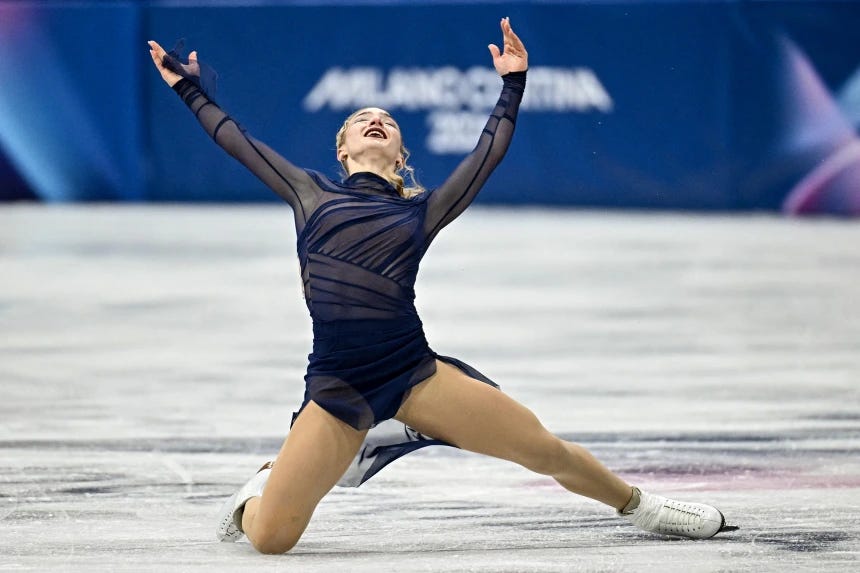
I watched her do her short program and miss an important element which landed her in 13th place. She came off the ice looking completely devastated. It was soul-crushing, she said.
I had heard somewhere that Amber had also taken a break from skating when she was younger. What I didn’t know was how dark the story behind that decision had been. Anxiety, eating disorders, suicidal ideation made her end up in a psychiatric facility in 2015. She’s said she didn’t want to be on this earth anymore.
But she came back to skating and won three consecutive national titles.
Now she talks about her struggles openly because she knows there are many athletes who are going through similar things in silence. She doesn’t pretend to have it figured out, to not suffer the pressure. Instead, she owns it. And she found the support she needed: neurofeedback, a mantra (believe and breathe), a coach who monitors her heart rate during competition. She did the work to make sure she had what she needed to keep going.
Two days after the soul-crushing short program, she came back and skated one of the best programs of her life. Moved from 13th to 5th. Landed a triple axel almost no one else in the free skate was even attempting. When she finished you could see the happiness in her face.
After Alysa won, Amber said: “If you consider your mental health and treat it right, great things can happen.” Read that sentence again. She’s celebrating her teammate but she’s still thinking about what can happen. Still outcome-adjacent. She messed up during the short program because she got in her head; because she was still, on some level, competing for something external, for validation.
But her free skate told a different story.
To me, Amber’s free skate was inspiring in a completely different way than the gold medal moment. I don’t think Amber thought she could win. She was too far behind; she knew the math. She went out there anyway. She wasn’t doing her free skate for the medal; she was proving that a mistake does not define us.
The world that made them
I read a piece in Time about Amber that felt familiar, like something that women face regardless of the arena where we’re playing:
“The anxiety was fueled by the sport’s competitive structure, which pits athletes against each other in a constant cycle of comparisons. As participants in a judged sport, skaters are trained at a young age to learn that everything about them — their appearance, their body shape, their costumes, their skating style — is open for criticism and praise.”
And then Amber herself:
“Competing at local competitions felt like life or death. Our coaches would pit us against each other, and at 10 years old, we were forced to have this competitiveness and comparison. It’s so toxic. That was our normal.”
I didn’t grow up skating. But I know this feeling. It’s LinkedIn. It’s that reflex to check where you are compared to everyone else, even when those people aren’t in your field, aren’t in your lane, aren’t even playing the same sport.
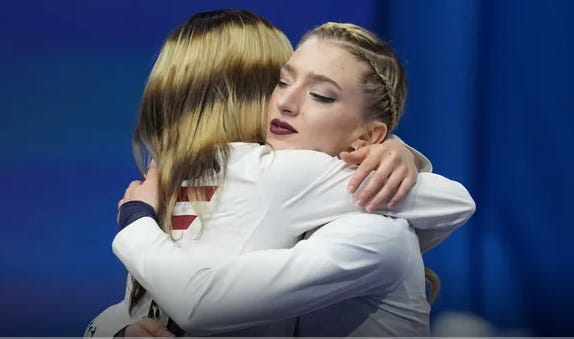
And yet — these two women who were literally competing against each other were holding each other up. Before Alysa skated, she came out looking for Amber. Wanted to find her, celebrate with her, tell her how well she’d done. I still tear up thinking about it. They found a way to support each other inside the same system that was built to pit them against each other. I want that. I want to get there.
Calling bullshit
It took me a long time to make sense of what I was feeling after the competition and after seeing all the discourse behind Alysa Liu’s gold medal win. That’s why I went down the rabbit hole of learning more about these skaters.
I loved what Alysa accomplished. I’ve smiled and cried every time I’ve watched her program, and I’ve watched it many times by now. Yes, at the beginning I wanted to call bullshit.
Bullshit on the idea that she doesn’t know what pressure is and someone needs to explain it to her. If you watch videos of her skating before she quit, you can see the pressure written all over her face. She does know what it feels like, she just doesn’t feel it anymore because she built a better relationship to it.
I wanted to call bullshit on the thought that she wasn’t doing it for the medals because I can’t believe a small part of her didn’t think about those.
Bullshit on the idea that she was always joyful, that it was all just fun.
In the 60 Minutes piece they showed footage of Alysa training. She fell over and over and she was still smiling. It’s a different thing to see someone struggle and smile than to see them perform flawlessly and be happy. And she said something I wrote down immediately: that she loves struggling because it makes her feel alive.
That’s what made it click for me. Joy and fun don’t mean something’s easy. In fact, if it was easy it would be boring. The falls are part of it, not obstacles to it. That’s not “skate for joy and the gold follows.” That’s a different relationship to difficulty altogether.
That’s what I want. To feel alive because of the struggles, not in spite of them.
I realized I wasn’t calling bullshit on Alysa and her joy. I was calling bullshit on myself. On the part of me that still believes joy can’t be real without the gold. The part that checks subscriber counts during commercial breaks and finds evidence of failure there. The part that can’t sit on a couch on a rainy Friday without it becoming proof of something fundamentally wrong with me.
I was watching someone skate with total freedom and judging her from inside my own cage.
I keep waiting for my comeback
It wasn’t just these two women.
Ilia Malinin, The Quad God. Fourteen wins in a row going into these Olympics. Favored for the gold. He got in his head and had a devastating free skate.
Alysa came back with all the joy and all the freedom, and still had to take the falls. Amber came with all the structure and all the support, and still wasn’t fully free. Ilia came with all the dominance and all the expectations, and none of it protected him from what was happening inside his head.
There’s no version of “prepared enough” that makes you immune to that. We’re all human, and no matter how much we rehearse, we have to quiet the voices in our head first. No external validation does that for you.
I remember people telling me my whole life that I was smart, that I’d accomplish great things. I think I still carry that voice. The one that says I wasted my potential, wasted my education, wasted all the support that was poured into me.
It may be part of what’s been keeping me from my own comeback since I left my old career behind.
The only way I’m going to come back is if I do it because I want to. Not because I think I should. Not to prove something to the voice.
I’m still working on untangling the idea that joy can’t be real without the gold.
But I want to believe.
And when the spiral starts again, maybe I just need to play MacArthur Park and watch Alysa spin on the ice.
She’s the inspiration we all need. Me included.
P.S. There's also a podcast episode where I worked through all of this out loud, unfiltered, for about 37 minutes. Which is a lot. But if that's your thing, it's here.